

Book a 1-2-1 meeting with our power experts at DataCentres Ireland 2026 to discuss practical ways to deliver resilient, flexible power infrastructure that’s ready for the future.
Complete your details in the form opposite, and one of our power experts will contact you to discuss your project requirements at the event.
Edina helps data centre developers and operators assess and deliver on-site power solutions tailored to the high-availability demands of critical infrastructure. As an EPC contractor, Edina integrates power generation, standby systems, battery storage and supporting infrastructure into a coordinated solution.
Depending on project requirements, on-site generation can supplement grid capacity, reduce exposure to grid constraints and offer greater flexibility in power procurement. Battery storage can provide fast-response flexibility and help manage demand, while standby generation supports the wider resilience strategy.
From engineering and system integration to installation, commissioning and ongoing maintenance, Edina provides a single delivery partner, reducing risk and ambiguity.
Data centres have traditionally relied on grid-supplied electricity, supported by standby diesel generators to provide resilience and continuity of supply. However, growing energy demand, grid capacity constraints, connection delays, rising energy costs and increasing sustainability requirements are driving operators to reassess how they secure reliable power.
On-site generation using containerised, lean-burn gas engines, alongside battery energy storage and integrated hybrid power systems, can offer alternative ways to meet power requirements, manage energy costs and support future expansion.
The right solution depends on your site's power demand, operational requirements and commercial objectives.
Explore the options below to identify the most suitable data centre power solution for your project.

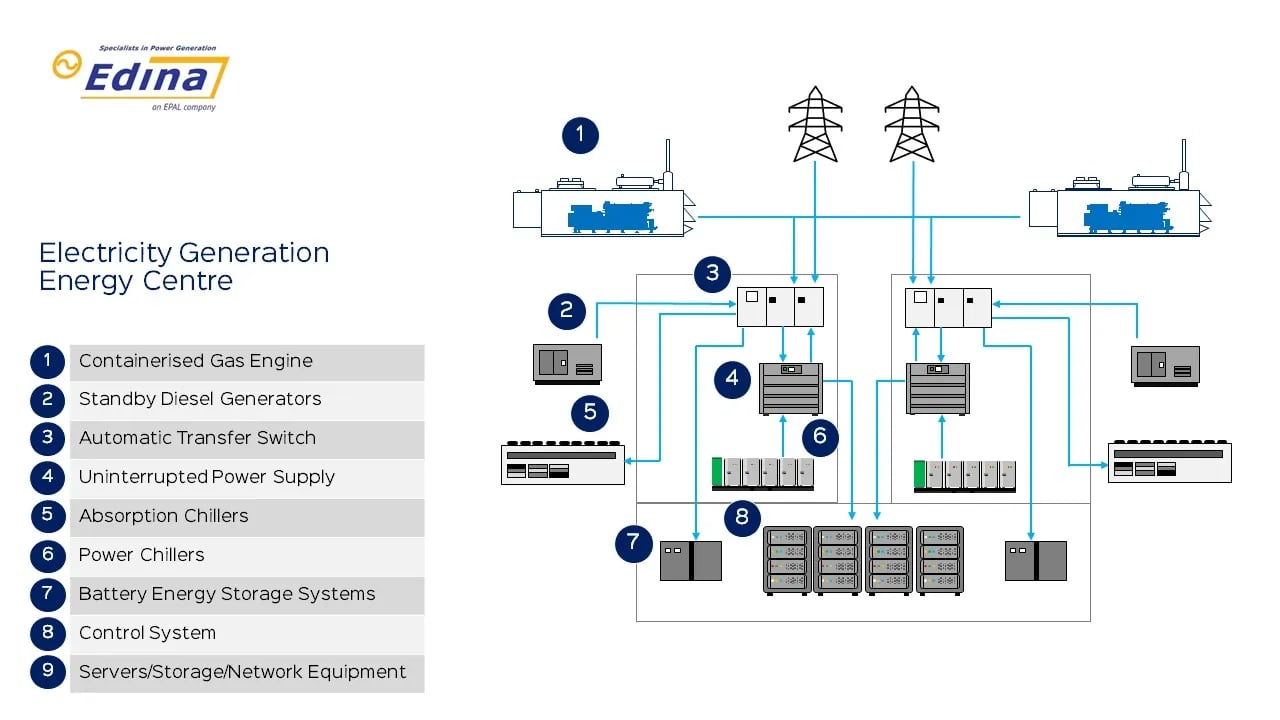
The data centres primary power is grid-supplied, and the provision of on-site gas engines add additional site resilience and capacity where networks are constrained. In this scenario, gas engines operate similarly to flexible generation plants and can produce electricity during high electricity price periods to manage the site operational costs.
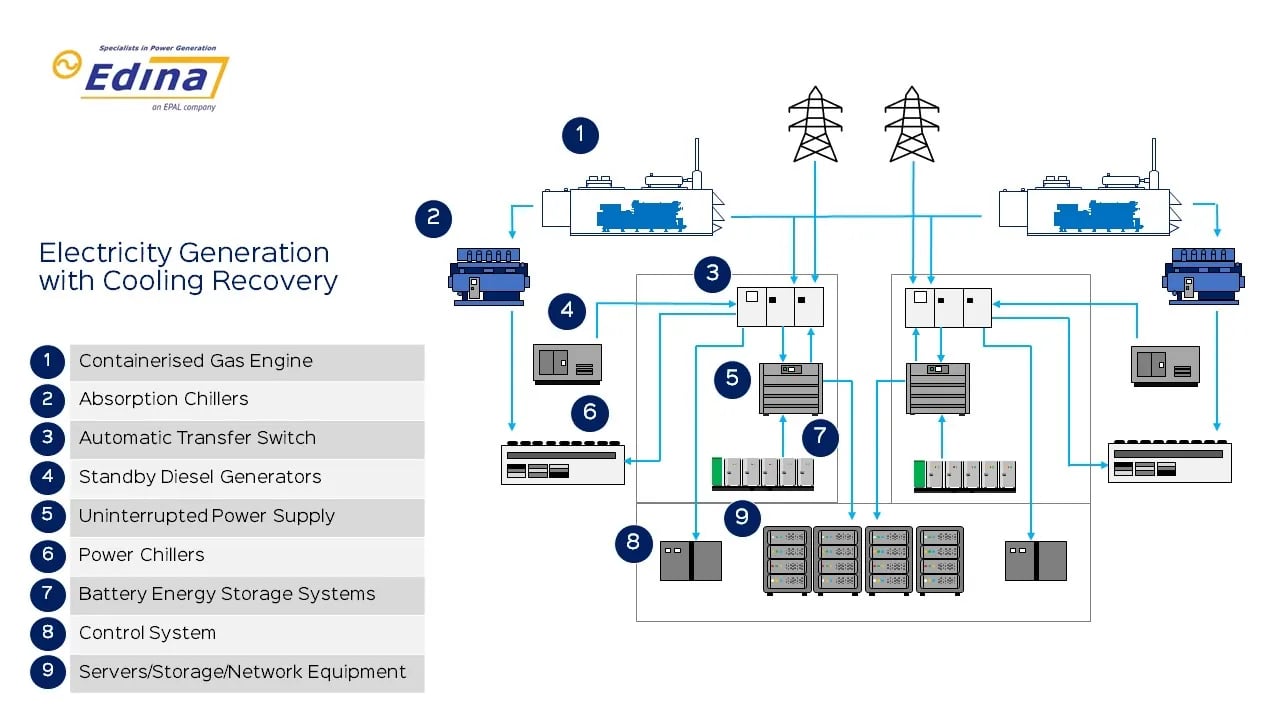
The data centres primary power is grid-supplied, and the provision of on-site gas engines add additional site resilience and standby power. Should there be a requirement for cooling, the data centre can introduce absorption chilling which can operate at temperatures as low as minus 5 degrees Celsius and support existing cooling infrastructure.
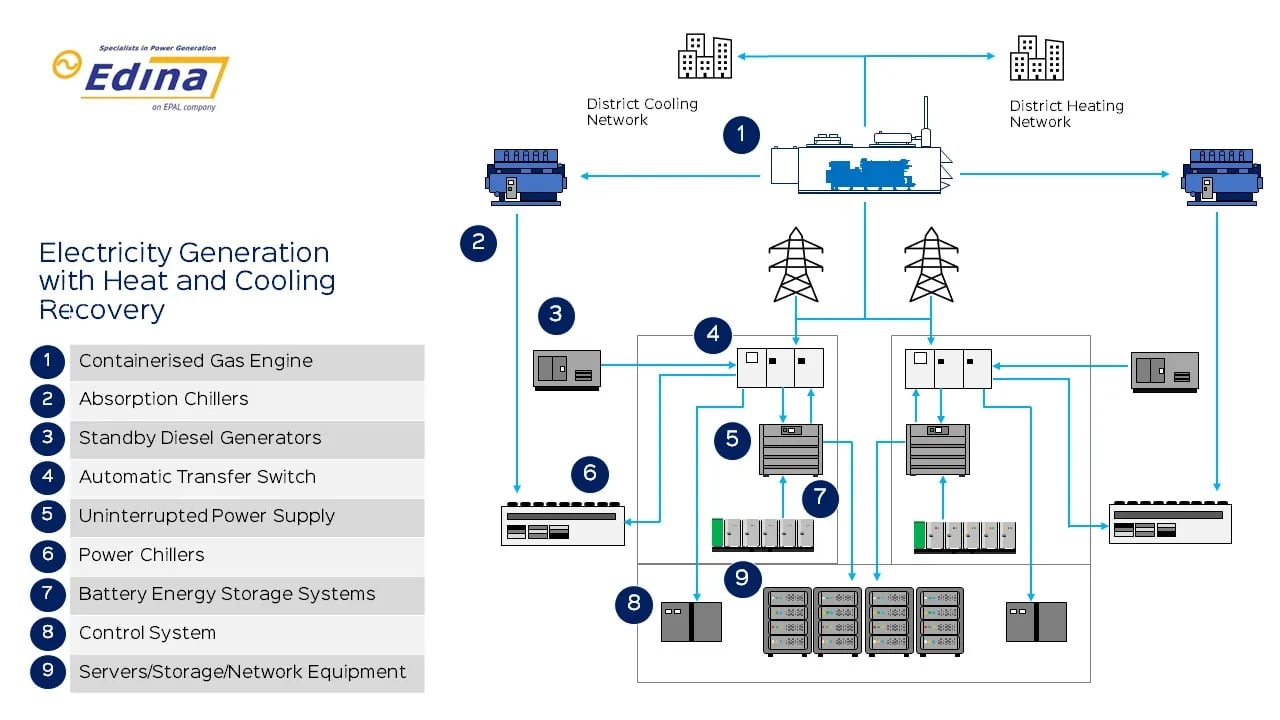
Primary power is supplied by the grid and gas engine assets provide secondary backup power adding additional site power resilience. Heat and cooling recovered from the engine can be used to power locally connected district energy networks ensuring optimised use of fuel source and engine asset.
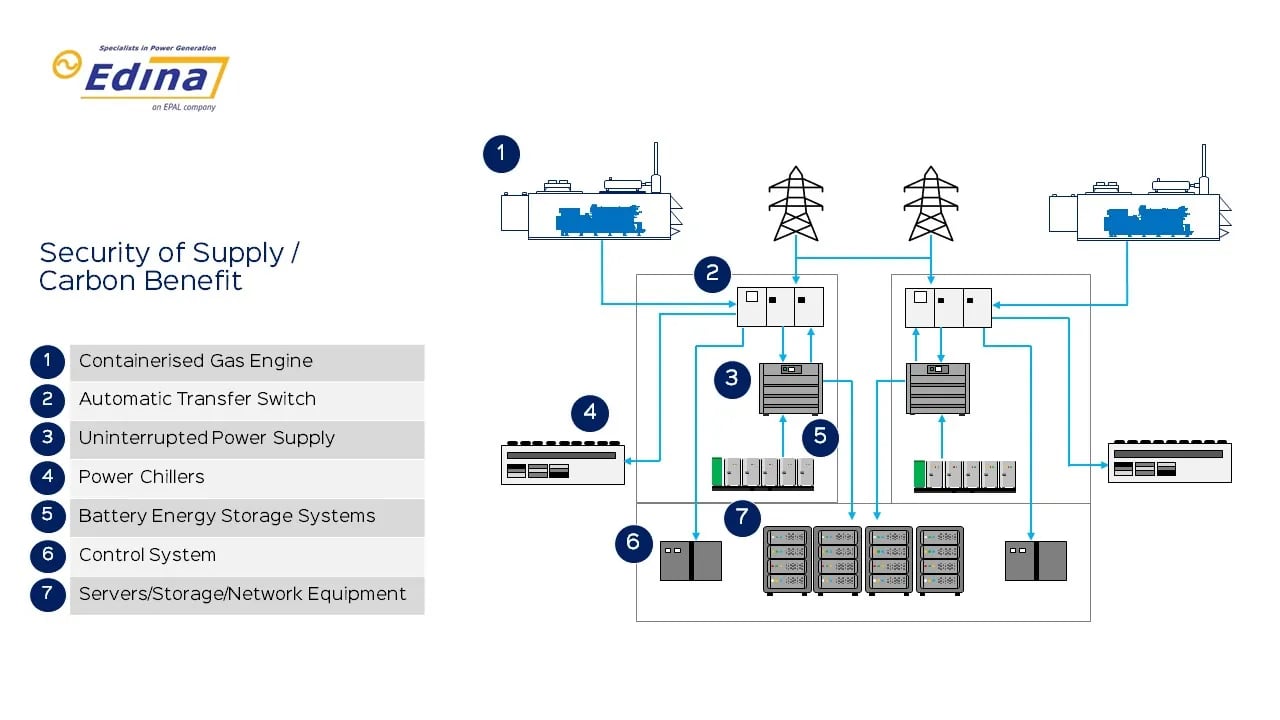
In this scenario, gas engines displace diesel generation to provide secondary low carbon reserve power, thus reducing on-site carbon emissions. Further efficiencies can be realised once the gas network accepts blended hydrogen mixes.
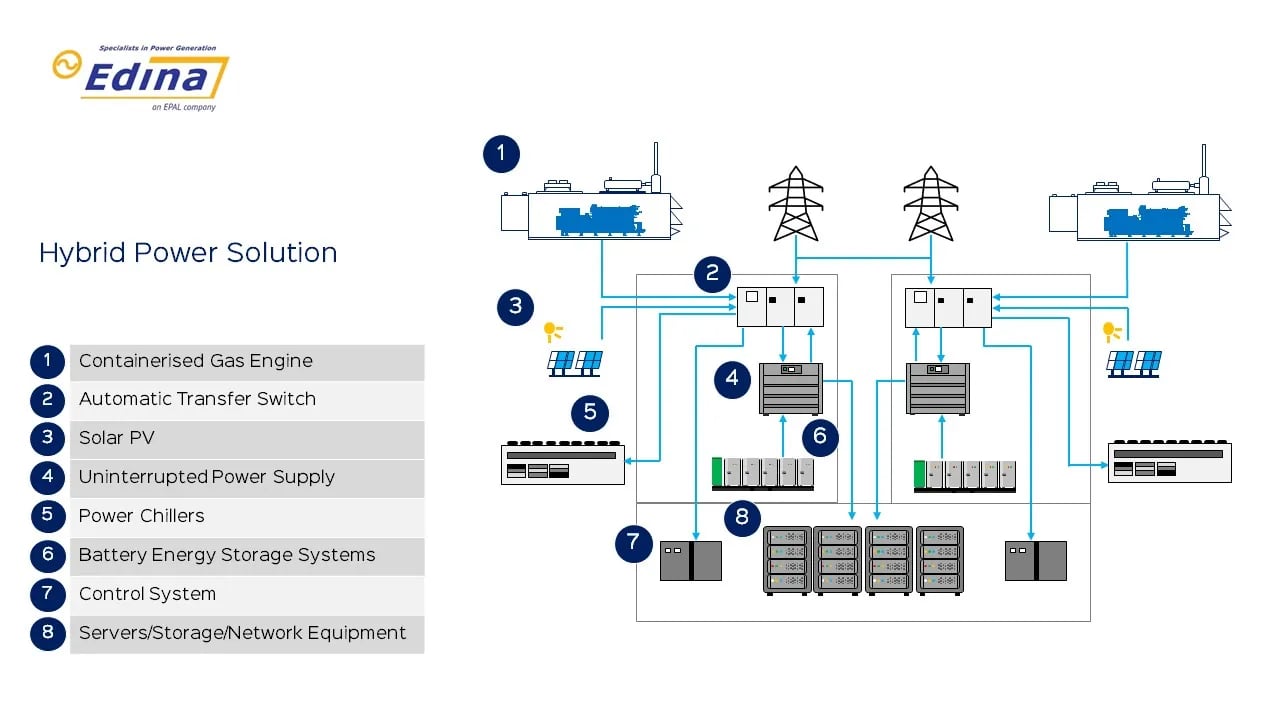
Gas engines can be integrated alongside a Battery Energy Storage System (BESS), wind, and solar photovoltaic technologies as part of a sustainable data centre power solution. Gas engines operating on low emission natural gas, renewable biogas, or hydrogen, provide reserve backup power and compliment renewable energy integration.
Battery storage can capture excess solar PV generation and store it for later use offsetting high time-of-day grid import charges or participate in demand side response services, offering asset flexibility and access to additional revenue streams.
Combined gas engines with BESS can also increase potential revenue streams from capacity grid services such as Fast Frequency Response (FFR), Primary Operating Reserve (POR) and Secondary Operating Reserve (SOR).
Under EirGrid’s Delivering a Secure, Sustainable Electricity System (DS3) programme, sites operating on renewable technologies could benefit from financial incentives for energy efficient plant performance.

Download Edina's whitepaper to explore the power challenges facing the sector, understand the role of on-site generation and integrated power solutions, and discover the key considerations for securing reliable power for your data centre.
Grid delays and rising electricity demand are increasing pressure on data centres to secure resilient, affordable and sustainable power.
There is no single solution. The strongest energy strategies combine on-site generation, battery storage, renewables, grid integration and intelligent control systems.
Gas reciprocating engines can provide speed to power ahead of grid connection, while supporting long-term resilience, energy cost savings, fuel flexibility and future decarbonisation pathways.
| 2027 | 2028 | 2029 | 2030 | 2031 | 2032 | 2033 | 2034 | 2035 | 2036+ | ||
| Network | Grid Connection | ||||||||||
| Speed to Market | Gas Recip Lead Time | ||||||||||
| Operational Asset | |||||||||||
| Commercial Benefit |
Asset Payback | ||||||||||
| Energy Cost Savings | |||||||||||
| Other Technology | CCGT Lead Time | ||||||||||
| Decarbonisation | Green Gas / Fuel Switching / Carbon Capture | ||||||||||
| Future Usage | Standby / Peaking / Capacity Market | ||||||||||
Edina provides EPC expertise, on-site generation solutions and grid integration capability for data centres requiring resilient power infrastructure.
Book a 1-2-1 meeting with our power experts at DataCentres Ireland 2026 to discuss practical ways to deliver resilient, flexible power infrastructure that’s ready for the future.


Copyright © Edina. All Rights Reserved.